
Software is full of decisions that are easy to describe and difficult to hard-code. Which team should handle this message? Which action is permitted? Is this evidence enough to continue?
Decoice is a decision model for those moments. Give it context, a question, and the criteria that matter. Get back a choice, a probability, or a score that your application can use directly.
Today we’re introducing Decoice 1.0.0 in Standard mode. This page explains the interface, shows the measurements, and lets you try the model. The results are promising. The conditions behind them matter just as much.
01 / THE INTERFACE
Some tasks need an answer.
Some need a decision.
A conversational model is useful when you need an explanation, a draft, or a piece of code. A decision model is useful when the next step is defined by your application—and you need to select, evaluate, or rank it.
| At the decision point | Decoice returns | Example |
|---|---|---|
| A set of alternatives | A choice and its distribution | Route to billing, support, or sales. |
| A proposition | A yes/no probability | Does this request need escalation? |
| An ordered scale | A score and its distribution | Assess urgency against a rubric. |
The surrounding software still owns permissions, execution, and fallback behavior. A structured answer is easier to integrate; it is not a guarantee that the decision is correct.
02 / EVALUATION
Put the comparison
on the page.
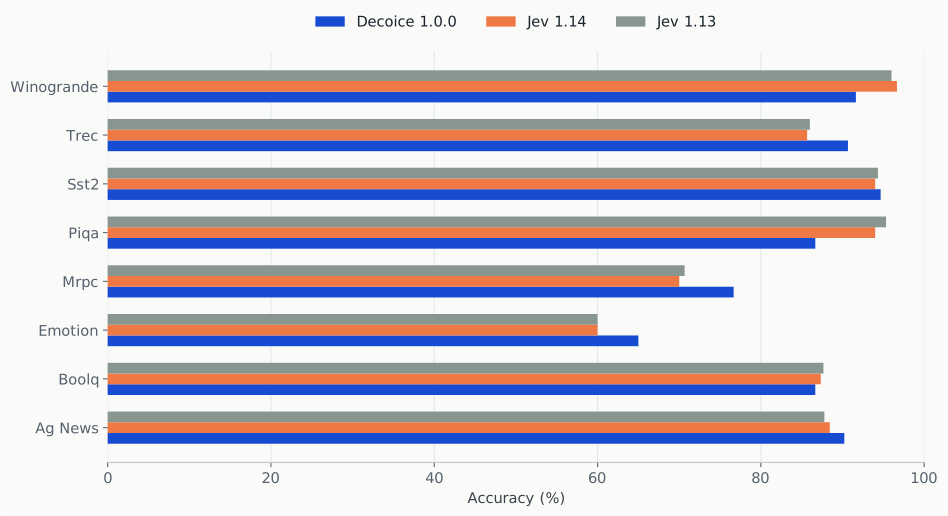
We compared Decoice 1.0.0 with Jev 1.14 and Jev 1.13 on three fresh project-held-out batches. The models received the same requests. The study includes natural language tasks, constructed policy checks, ordinal judgments, and uncertainty cases.
| Model | Overall | Natural | Mean | p95 |
|---|---|---|---|---|
| Decoice 1.0.0 | 88.95% | 85.49% | 63.6 ms | 76.9 ms |
| Jev 1.14 | 86.79% | 84.17% | 99.4 ms | 142.6 ms |
| Jev 1.13 | 87.84% | 84.25% | 96.8 ms | 136.9 ms |
Beyond the headline numbers.
Explore 28 measures across correctness, confidence, selective risk, speed and reliability. The highlighted result changes with the question you ask.
| Metric | Decoice 1.0.0 | Jev 1.14 | Jev 1.13 |
|---|---|---|---|
| Overall accuracy ↑Hard-label judgments: 3,149 / 3,150 / 3,150; includes constructed checks. | 88.95% | 86.79% | 87.84% |
| Natural accuracy ↑Natural examples: 2,399 / 2,400 / 2,400. | 85.49% | 84.17% | 84.25% |
| Brier score ↓Squared probability error across all evaluated judgment types. | 0.1696 | 0.1874 | 0.1829 |
| Log loss ↓All judgment types; probabilities clipped at 10⁻¹⁵. | 0.4572 | 0.9223 | 1.0859 |
| Natural log loss ↓Probability loss on natural examples only. | 0.6015 | 1.2310 | 1.4729 |
| Ordinal score MAE ↓150 constructed ordinal checks; not a natural-task accuracy measure. | 0.00037 | 0.18660 | 0.13967 |
| Ordinal ranked probability score ↓150 constructed ordinal checks; cumulative distribution error. | 0.000001 | 0.046828 | 0.023343 |
Highlighted cells are the best observed values in this study, not significance tests. ↑ Higher is better. ↓ Lower is better. All categories use the saved reviewed results; each metric’s denominator and scope are stated.
Natural examples, batch by batch.
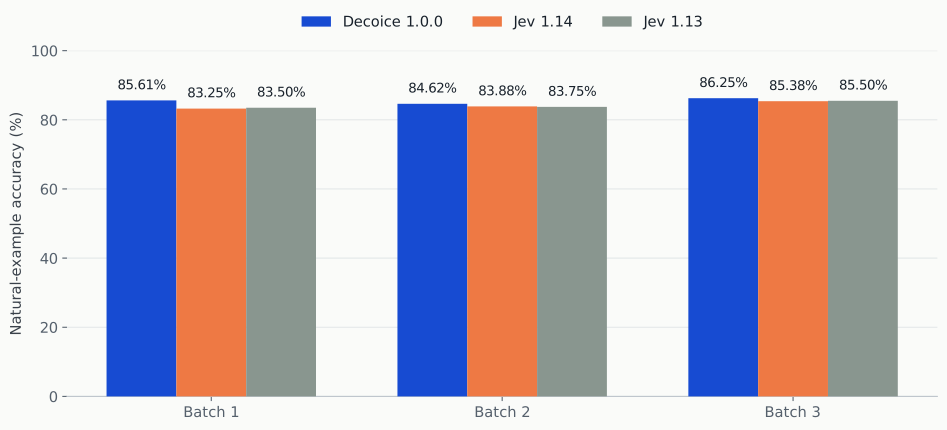
Decoice’s observed natural-example accuracy was higher in all three batches. On shared successful examples, its combined lead was 1.33 percentage points over Jev 1.14 and 1.25 points over Jev 1.13. Both 95% confidence intervals include zero. We report an observed lead, not statistically established general superiority.
Measure the whole response.
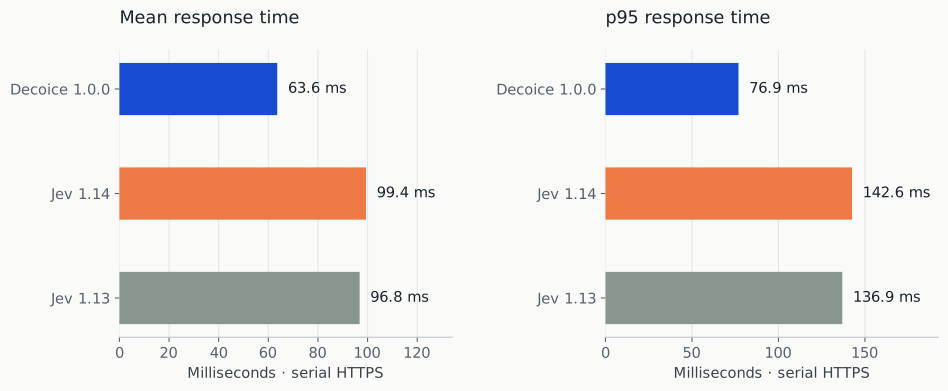
A short serial test, a busy API, and a client on another continent are different conditions. Our previously qualified loaded Standard test reached 381.48 ms at the worst-cohort p95; those load results are kept separate from the fresh serial comparison above.
Full results, denominators, and methodology →03 / CONFIDENCE
Correctness is only
part of the evidence.
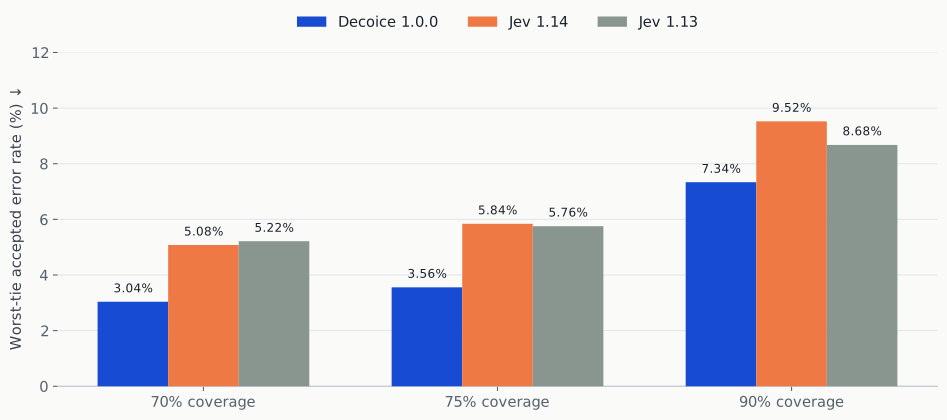
A model can get more answers right and still be too confident when it is wrong. We evaluate calibration, probability error, and selective risk as well as accuracy.
Where confidence helps—and where it doesn’t.
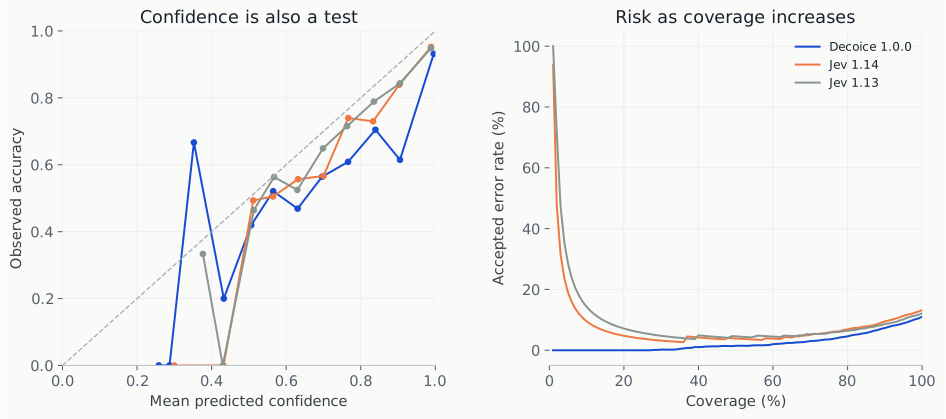
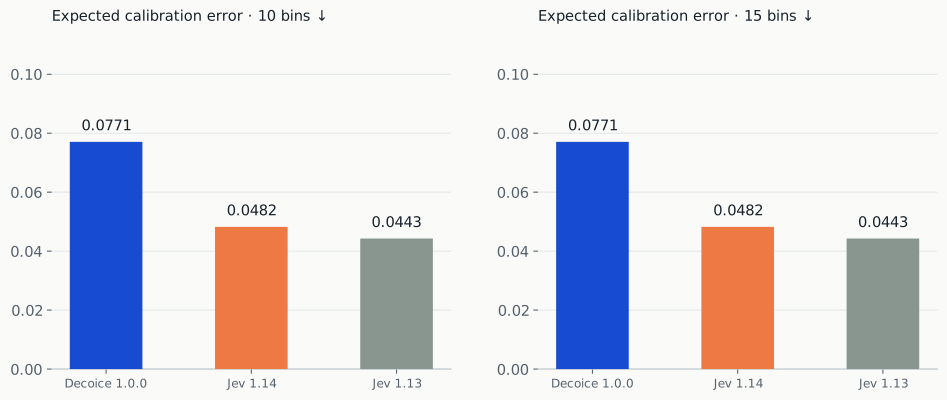
In this study, Decoice had lower aggregate Brier score and log loss, while both Jev versions had lower expected calibration error. Validate thresholds for your own workload, and keep a human fallback where mistakes are consequential.
When an answer is wrong, how wrong is its confidence?
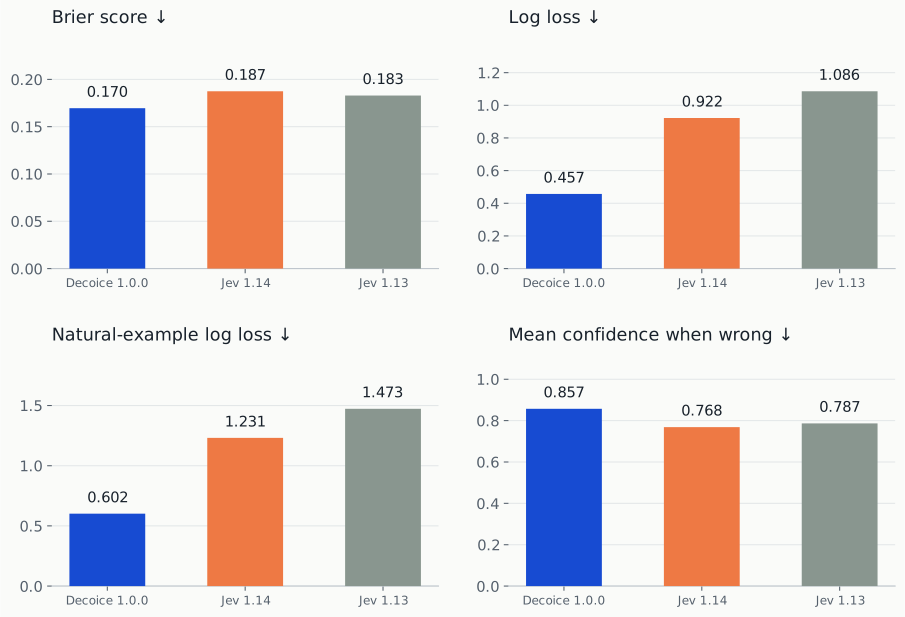
A metric where Jev leads.
What happens when you accept fewer decisions?
Different tasks tell different stories.
04 / DEMONSTRATIONS
A decision inside
an ordinary application.
The useful unit is often a small decision inside a larger workflow. Try four real API workflows, then explore the evidence behind the product.
Inbox triage
Route a customer message to the right team.
Browser action
Choose a permitted next step from visible actions.
Coding workflow
Prioritize investigation before deployment.
Resource game
Choose an action from structured game state.
These examples make real Decoice requests. They demonstrate an integration pattern, not measured success at autonomous browsing, software engineering, or competitive gameplay.
05 / PRICE & ACCESS
A small interface.
An explicit price.
per million input tokens
output-token charge
provisioned API access
This is our chosen launch price, not a claim about infrastructure margin or unlimited capacity. Account-specific rate and concurrency limits apply. Fast mode is not part of this launch.
The API accepts up to 128 questions, choice menus of 2–255 alternatives, and ordered scales of 2–10 levels, within a 256 KiB request body. A public input-token context limit has not yet been qualified; we will publish the measured limit rather than infer one from internal configuration.
06 / FAQ
A few good questions.
Is Decoice a chatbot?+
No. Its public interface returns typed decisions: choices, binary probabilities, and ordinal scores. It does not generate conversational answers.
Does a typed response mean the answer cannot be wrong?+
No. Output structure and semantic correctness are different properties. The model can choose the wrong option or assign an inaccurate probability.
Did Decoice beat Jev in this evaluation?+
It had higher observed overall and natural-example accuracy on these batches. The paired natural-accuracy confidence intervals include zero, and Jev had better calibration error. We publish the complete results rather than a universal winner claim.
Why is this accuracy different from the earlier 89.94% figure?+
The earlier figure belongs to a different preserved benchmark. Fresh examples change the measurement. This study reports 88.95% overall and 85.49% natural-example accuracy on successful Decoice responses.
How should I use probabilities?+
As estimates to validate on your application, not guarantees. Measure calibration and the consequences of errors before setting an automation threshold.
Can I use it through OpenRouter?+
The current integration is the direct Decoice Decisions API. An OpenRouter listing is not announced as available.
Will the API always respond within the benchmark time?+
No. Input size, client location, traffic, and availability affect latency. Benchmark percentiles describe their stated conditions, not every request or every region.
Build at the decision point.
Start with a question your application already needs to answer.